Wednesday, September 30, 2009
The joy of forgiveness
Psalm 31, Psalm 32. Today I could talk about genres again and other forms of literary criticism of these passages, but I'm not going to. The reason people across the traditions and ages resonate with the psalms is because of the deeply human and universal themes. I live in a very different time and place that the writer of psalm 32, but I can identify with the joy of forgiveness that's expressed here, beginning with the first verse: "Happy are those whose transgression is forgiven, whose sin is covered." The psalmist writes about the consequences of not forgiving, wasting away and suffering (v. 3-4) and the sense of relief from moving from anger to forgiveness. Being stubborn like a mule isn't an answer to deep emotional pain (v. 9), but faith and prayer are. I've found that moving to a place of forgiveness can be a long and difficult journey, and it is easy and very tempting to give in to the anger and hurt. If I can get past that and move to a place of faith and trust, I'm saying with the psalmist: "Be glad in the Lord and rejoice, O righteous, and shout for joy, all you upright in the heart." (v.11).


Tuesday, September 29, 2009
Hymns and personal thanksgiving
Psalm 29, Psalm 30.
Psalm 29 is characterized as a hymn of thanksgiving that was intended for use in worship. In some ways it is difficult to read a hymn of praise to God's glory that was meant for community worship in the context of my home office. This is something that was meant to be shared and proclaimed, not quietly responded to. Even the image is dramatic -- referring to thunder and power and majesty and flames of fire and shaking the wilderness. Hardly the stuff for individual reflection.
Gunkel puts Psalm 30 in the category of individual psalms in the sub-group of personal thanksgiving, also used in worship, perhaps in conjunction with a sacrifice. This psalm has two oft-quoted verses: "weeping may linger for the night, but joy comes with the morning" (5b) and "you have turned my mourning into dancing; you have taken off my sackcloth and clothed me with joy." ( 11).
Today marks two weeks of blogging: only nine more to go! Some days this is easy, but today I found putting together coherent words more difficult. Thanks to those of you who are still reading this regularly.
Psalm 29 is characterized as a hymn of thanksgiving that was intended for use in worship. In some ways it is difficult to read a hymn of praise to God's glory that was meant for community worship in the context of my home office. This is something that was meant to be shared and proclaimed, not quietly responded to. Even the image is dramatic -- referring to thunder and power and majesty and flames of fire and shaking the wilderness. Hardly the stuff for individual reflection.
Gunkel puts Psalm 30 in the category of individual psalms in the sub-group of personal thanksgiving, also used in worship, perhaps in conjunction with a sacrifice. This psalm has two oft-quoted verses: "weeping may linger for the night, but joy comes with the morning" (5b) and "you have turned my mourning into dancing; you have taken off my sackcloth and clothed me with joy." ( 11).
Today marks two weeks of blogging: only nine more to go! Some days this is easy, but today I found putting together coherent words more difficult. Thanks to those of you who are still reading this regularly.
Monday, September 28, 2009
Confidently lamenting
Psalm 27, Psalm 28. The opening six verses of Psalm 27 are a song of trust (1-6) followed by an individual lament. I haven't spoken much about form criticism (pioneered by Herman Gunkel) in these postings, but this is one of those psalms that doesn't neatly fit into the categories. Gunkel puts the second part into the lament category, following expressions of trust and confidence. This lament includes the image of seeking the face of the Lord, a recurring theme in the Psalms, where the psalmist expresses feelings of abandonment by God.
I like the idea of confidently lamenting. It's easy to complain or plead for help, but it shows the depth of the relationship when the psalmist voices the lament in the context of praise and trust. It's like conversations I have with old and trusted friends, where we move quickly from one topic to another, knowing that the strength and length of the relationship can handle the ups and downs. "The Lord is my light and my salvation; whom shall I fear?" v.1, followed by the plea: don't hide from me, don't leave me.
A quick note on Psalm 28: here's the first reference to the Lord being a shepherd (v. 9) after the famous and familiar shepherd psalm (23).
I like the idea of confidently lamenting. It's easy to complain or plead for help, but it shows the depth of the relationship when the psalmist voices the lament in the context of praise and trust. It's like conversations I have with old and trusted friends, where we move quickly from one topic to another, knowing that the strength and length of the relationship can handle the ups and downs. "The Lord is my light and my salvation; whom shall I fear?" v.1, followed by the plea: don't hide from me, don't leave me.
A quick note on Psalm 28: here's the first reference to the Lord being a shepherd (v. 9) after the famous and familiar shepherd psalm (23).
Sunday, September 27, 2009
Sunday quote
Readings: Psalms 25 and 26.
Quote for today:
Quote for today:
Be mindful of your mercy, O Lord, and of your steadfast love,
for they have been from old.
Do not remember the sins of my youth or my transgressions;
according to your steadfast love
remember me,
for your goodness' sake, O Lord!
Psalm 25: 6,7
Saturday, September 26, 2009
So how do you read Psalm 23?
Psalm 23, Psalm 24: Today's reading includes one of the most well-known and familiar Psalms, one that most people could recite or sing, regardless of how connected they are to a church. In The Psalms Through Three Thousand Year: Prayerbook of a Cloud of Witnesses, William Holliday views this psalm as an American secular icon , especially for Protestants, a prayer or poem recited at deathbeds and funerals and quoted in 19th century literature. He suggests a few reasons: it is short and easy to memorize, undemanding and doesn't mention sin. (p. 364). Last year my son had to choose a favourite psalm for his grade 7 Christian studies class, and this is the one he chose to memorize and then present to his class, telling the story from the perspective of a sheep with the help of a large muppet-style puppet wearing a sheep costume. Although this is a well-known psalm, it doesn't rank as my favourite, although I could recite it or sing it along with most of you. Of the two psalms today, 24 is more evocative for me, a liturgy for entrance into the sanctuary, one that is much used in hymnody and the last three verses are part of a well-known chorus in Handel's Messiah "Lift up your heads, o ye gates."
Friday, September 25, 2009
All my bones are out of joint
Psalm 21 and Psalm 22: So far I've been resonating with the psalms of lament more than the royal psalms or the psalms of victory (Ps. 21.) Psalm 22 goes through the cycle scholar John Hayes outlines: addressing the deity (v.1), complaint (v. 2) and feeling that God does not answer the cry for help, the motivation for divine intervention (v. 3-5), and the confession of sin (v. 6). That cycle is repeated several times in the 31 verses. What I like is the imagery in the second complaint cycle of the lament: "I am poured out like water, and all my bones are out of joint; my heart is like wax; it is melted within my breast." I've had my bones out of joint and it is a lamentable condition. I just returned from my 31st visit to the chiropractor since I was injured in a car accident in January, and sometimes I've felt exactly as the psalmist describes. I'm recovering well, but slowly, another lamentable fact. Today the chiropractor talked about living with a new reality -- after the early weeks of lamenting the fact of my injuries, I'm now ready to move on to what is, instead of what was before. Yesterday in class, we discussed Walter Brueggemann's article, "The Costly Loss of Lament" (JSOT 35 (1986):57-71) where he says that laments served a necessary and important function in Israelite worship, helping people move from pleas to praise. He says: "A community of faith which negates laments soon concludes that the hard issues of justice are improper questions to pose at the throne, because the throne seems to be only a place of praise." Brueggemann makes other good points, and I'll refer back to him in the days ahead.
Thursday, September 24, 2009
Let the words...
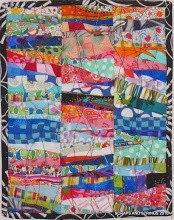
Psalms 19, 20. Today's reading is partly about words and speech and communication, something I do for a living as well as for fun. For the past two years I've been working on this word quilt, which is pieced but not quilted. It is my lament on the limitations of words: words fail me. (You can click on the image to make it bigger, and then you will see that each letter is made from fabric printed with words.)
 In Psalm 19, the Psalmist speaks about the limitations of words, and how messages of God's glory can be communicated without the limitations of words, and that the knowledge of God transcends speech and voice and language. That's humbling and yet comforting to realize. As a writer, I'm very aware of the power of words, yet that they are a mere shadow of the reality I'm trying to portray. I'm also aware that language is a very human exercise, and even with all the new media out there that provides instant communication, we are still limited by words. Interesting then, that this Psalm ends with more words about words, a benediction for today: "Let the words of my mouth and the meditation of my heart be acceptable to you, O Lord, my rock and my redeemer."
 In Psalm 19, the Psalmist speaks about the limitations of words, and how messages of God's glory can be communicated without the limitations of words, and that the knowledge of God transcends speech and voice and language. That's humbling and yet comforting to realize. As a writer, I'm very aware of the power of words, yet that they are a mere shadow of the reality I'm trying to portray. I'm also aware that language is a very human exercise, and even with all the new media out there that provides instant communication, we are still limited by words. Interesting then, that this Psalm ends with more words about words, a benediction for today: "Let the words of my mouth and the meditation of my heart be acceptable to you, O Lord, my rock and my redeemer."
Wednesday, September 23, 2009
More than enough
Psalms 17 and 18: The end of Psalm 17 reminds me of Canadian social reformer J.S. Woodsworth, whom I've been reading about this week for another course. Woodsworth was a Methodist minister, proponent of the social gospel and founder of CCF (precursor to NDP) was moved to lobby for changes to economic structures so the cycle of poverty wouldn't be perpetuated. He moved from saving souls to saving body and souls, writes his daughter Grace McInnis in A Man to Remember: She quotes one of his articles: ""At least in this world, souls are always incorporated in bodies; and to save a man, you must save his body, soul, and spirit. To really save one man, you must transform the community in which he lives.'" (p. 91).
In Psalm 17, a prayer of deliverance from persecutors, the Psalmist expresses the hope that mortals in this life have enough and "may their children have more than enough; may they leave something over to their little ones." Perhaps this could be interpreted as enough faith and security or spirituality, but I'm thinking, like Woodsworth, we can't separate our bodies from our spirits. And I'm thinking the Psalmist would agree that transformation has to be communal, not just individual. Psalm 18 is the longest Psalm I've encountered so far -- 50 verses of a thanksgiving for victory, also found in 2 Samuel 22. I suppose I should read it there in the context of the narrative.
In Psalm 17, a prayer of deliverance from persecutors, the Psalmist expresses the hope that mortals in this life have enough and "may their children have more than enough; may they leave something over to their little ones." Perhaps this could be interpreted as enough faith and security or spirituality, but I'm thinking, like Woodsworth, we can't separate our bodies from our spirits. And I'm thinking the Psalmist would agree that transformation has to be communal, not just individual. Psalm 18 is the longest Psalm I've encountered so far -- 50 verses of a thanksgiving for victory, also found in 2 Samuel 22. I suppose I should read it there in the context of the narrative.
Tuesday, September 22, 2009
Who shall abide in God's Sanctuary?
Psalm 15 and 16: Psalm 15 lists the qualities of those who may abide in God's tent--people who walk blamelessly, do what is right, speak the truth but don't slander, and treat their friends and neighbours well, including not lending money at interest. This list is prescriptive but it also reminds me of two other "lists" of what people should do: Micah 6:8 -- do justice, love kindness, and walk humbly with your God (a text that was used as the basis of the sermon in my church last Sunday) and of course Jesus' admonition to love God and to love your neighbour. In my readings so far, this is the first mention in the Psalms about what people of God are to "do."
Psalm 16 is a song of trust and security in God, a prayer of an individual asking for continual protection and guidance. The psalmist is confident in the relationship with God: "You show me the path of life. In your presence there is fullness of joy; in your right hand are pleasures forevermore. (v.11)."
Note: This marks my first full week of blogging the Psalms, and I'm wondering if this is a sustainable exercise. I see the value in reading the Psalms consecutively but I'm wondering if I can continue to have new insights and reflections. I'm reluctant to be too personal in an on-line setting.
Psalm 16 is a song of trust and security in God, a prayer of an individual asking for continual protection and guidance. The psalmist is confident in the relationship with God: "You show me the path of life. In your presence there is fullness of joy; in your right hand are pleasures forevermore. (v.11)."
Note: This marks my first full week of blogging the Psalms, and I'm wondering if this is a sustainable exercise. I see the value in reading the Psalms consecutively but I'm wondering if I can continue to have new insights and reflections. I'm reluctant to be too personal in an on-line setting.
Monday, September 21, 2009
How about a plea for help with a fever?
Psalm 13 and 14: The challenge of reading the Psalms consecutively is that I may not be in the mood or frame or mind for a praise psalm or a plea for help, but that might be one I have to read next. Today's psalms are a prayer of deliverance from enemies (13) and a denunciation of godlessness (14). I'm dealing with deadlines and a fevered child today and neither of these readings suits my frame of mind. I'd rather sit and lament, and then move on.
So I'll leave you with a quote about a consecutive reading of the psalms from Norman Whybray in Reading the Psalms as a Book JSOT 22, Sheffield Academic Press, 1996:
"Readers find themselves caught up in worship not merely in moods that they find most congenial at the moment of reading, but successively into a variety of different moods, and in an order that they have not chosen for themselves but that has already been laid down for them. They are thus constrained to enter into the whole range of human situations, with which they can in some sense empathize and so adapt to their faith." p. 11.
Perhaps my enemy today is a fever?!
So I'll leave you with a quote about a consecutive reading of the psalms from Norman Whybray in Reading the Psalms as a Book JSOT 22, Sheffield Academic Press, 1996:
"Readers find themselves caught up in worship not merely in moods that they find most congenial at the moment of reading, but successively into a variety of different moods, and in an order that they have not chosen for themselves but that has already been laid down for them. They are thus constrained to enter into the whole range of human situations, with which they can in some sense empathize and so adapt to their faith." p. 11.
Perhaps my enemy today is a fever?!
Sunday, September 20, 2009
The more things change, the more they stay the same
A quote from my reading of Psalm 11 and 12:
Help, O, Lord, for there is no longer anyone who is godly;
the faithful have disappeared from humankind.
They utter lies to each other;
with flattering hearts and a double heart they speak (12:1-2).
You, O Lord will protect us,
you will guard us from this generation forever (12.7).
Note: On Sundays, I'm taking a pause from blogging, so I'm only posting a quote.
Saturday, September 19, 2009
A poetic start to the weekend
Psalm 9, 10: These two Psalms are supposed to be read as a unit, and in Hebrew they followed an alphabetic acrostic pattern, the notes say in the Harper Collins Study Bible. It's only sheer dumb luck that I'm reading them as a unit, and at first glance, they're not that unified. Psalm 9 begins with thanksgiving and praise, and Psalm 10 has the superscription "prayer for deliverance from enemies." But taken as a whole, the Psalm moves from proclaiming a wonderful and mighty God who rebuked the wicked and "let the nations know they are only human" (10: 20) to times of trouble where the wicked are arrogant in their prosperity and feel invincible, back to a victorious God. Another theme running throughout these two Psalms is the need for care and justice for the poor and oppressed.
A musical inspiration: The contemporary hymn Je louerai l'Eternel or Praise, I will praise you, Lord by Claude Fraysee is based on Psalm 9: 1-2. It's in my hymnal (HWB 76) but I know this is one that is widely sung across the Christian traditions.
A musical inspiration: The contemporary hymn Je louerai l'Eternel or Praise, I will praise you, Lord by Claude Fraysee is based on Psalm 9: 1-2. It's in my hymnal (HWB 76) but I know this is one that is widely sung across the Christian traditions.
Friday, September 18, 2009
Out of the mouths of babes and infants
Psalm 7 and 8: Today's reading has many vivid images: a lion tearing me apart (7:2), God as a shield and righteous judge or archer (7: 10-13); persecutors who "conceive evil and are pregnant with mischief "(7:14) and the phrase in the title (8:2). Yesterday in class we discussed the literary devices used by the Psalmist, and how the way the Psalms are written is intertwined with its content. The Psalms are a gold mine for someone like me who loves words, images, metaphors, and a turn of the phrase.
I'm reading the Psalms chronologically over 11 weeks, which seems to be a large enough task, but if I were Eastern Orthodox, I might be reading them all in a week. Check out this link to see how that's organized. Or I could be reading the Psalms with Luther as outlined in this book, or go at it a bit slower and read the New Testament, Proverbs, and the Psalms on the 365-day plan like this.
Since it's Friday, I've been thinking about the weekend and how much time I'll have for this project on busy weekend days. I'll post Saturday, but on Sundays, I'll only be posting a quote of the day's reading, just to give myself a bit of a pause day.
I'm reading the Psalms chronologically over 11 weeks, which seems to be a large enough task, but if I were Eastern Orthodox, I might be reading them all in a week. Check out this link to see how that's organized. Or I could be reading the Psalms with Luther as outlined in this book, or go at it a bit slower and read the New Testament, Proverbs, and the Psalms on the 365-day plan like this.
Since it's Friday, I've been thinking about the weekend and how much time I'll have for this project on busy weekend days. I'll post Saturday, but on Sundays, I'll only be posting a quote of the day's reading, just to give myself a bit of a pause day.
Thursday, September 17, 2009
With stringed instruments and flutes and a Mennonite hymnbook
Readings for the day: Psalms 4 to 6. All three of these Psalms, prayers for help in trouble or illness, have notations about the accompanying instruments of strings or flutes. The former clarinetist in me thinks the Psalmist probably would have included clarinets too, if they'd been invented back then. So these are songs meant to be sung and played, not just read.
In that spirit, I'm calling on another resource: Hymnal: A Worship Book, Scottdale, PA: Mennonite Publishing House, 1992, to check out how we sing these hymns in the churches of today (or at least in my tradition: Mennonite Church Canada). I'm not surprised to see there are four hymns based on these Psalms.
Lead Me Lord (HWB: 538) is a short, one stanza anthem written by Samuel S. Wesley in 1861 combining 5:8 and 4:8 and citing them nearly verbatim, depending on the translation: "Lead me Lord, lead me in thy righteousness. Make thy way plain before my face (5:8) For it is thou, Lord, thou, Lord, only that makest me dwell in safety (4:8)." A nice bit of pulling two ideas together, and a very effective hymn conveying the essence of two Psalms in one go. Wesley must have been a journalist as well!
One more thing: Psalm 6 is a prayer for recovery from a grave illness. I'm not recovering from an illness, but a back injury suffered in a motor vehicle accident too many months ago. It's progressing as well as could be expected, but it hurts to sit for long periods, and today it was painful when I got up. So I'm resonating with the writer here in 6: 2-3: "O Lord, heal me, for my bones are shaking with terror....O Lord, how long?"
In that spirit, I'm calling on another resource: Hymnal: A Worship Book, Scottdale, PA: Mennonite Publishing House, 1992, to check out how we sing these hymns in the churches of today (or at least in my tradition: Mennonite Church Canada). I'm not surprised to see there are four hymns based on these Psalms.
Lead Me Lord (HWB: 538) is a short, one stanza anthem written by Samuel S. Wesley in 1861 combining 5:8 and 4:8 and citing them nearly verbatim, depending on the translation: "Lead me Lord, lead me in thy righteousness. Make thy way plain before my face (5:8) For it is thou, Lord, thou, Lord, only that makest me dwell in safety (4:8)." A nice bit of pulling two ideas together, and a very effective hymn conveying the essence of two Psalms in one go. Wesley must have been a journalist as well!
One more thing: Psalm 6 is a prayer for recovery from a grave illness. I'm not recovering from an illness, but a back injury suffered in a motor vehicle accident too many months ago. It's progressing as well as could be expected, but it hurts to sit for long periods, and today it was painful when I got up. So I'm resonating with the writer here in 6: 2-3: "O Lord, heal me, for my bones are shaking with terror....O Lord, how long?"
Wednesday, September 16, 2009
Day 2, Psalms 2 and 3
For those folks who have sung Handel's Messiah, the first verse of Psalm 2 is familiar as part of that great oratorio: "Why do the nations conspire, and the people plot in vain?" This opening verse is part of a larger royal psalm meant for an occasion like the coronation of a king. The whole Psalm refers to political intrigue and cautions leaders to be wise and faithful, words that ring true today when the Canadian prime minister meets with the American president.
Psalm 3 switches gears, credited to David when he fled from to his son Absalom, and is the first lament in the book: "O Lord, how many are my foes?" (v.1). This Psalm also introduces one of the common themes throughout the entire book, the idea of the holy hill, Zion or the Temple Mount (v.4).
Most striking metaphor today: the need for dental work in Psalm 3:7:
Rive up, O Lord! Deliver me, O God! For you strike all my enemies on the cheek; you break the teeth of the wicked."
Psalm 3 switches gears, credited to David when he fled from to his son Absalom, and is the first lament in the book: "O Lord, how many are my foes?" (v.1). This Psalm also introduces one of the common themes throughout the entire book, the idea of the holy hill, Zion or the Temple Mount (v.4).
Most striking metaphor today: the need for dental work in Psalm 3:7:
Rive up, O Lord! Deliver me, O God! For you strike all my enemies on the cheek; you break the teeth of the wicked."
Tuesday, September 15, 2009
Day 1, Psalm 1
This is a short six-verse Psalm to open this project. Two images jump out at me: the metaphor of righteous folk being like trees planted by streams of water (v. 3) and wicked being compared to chaff blown about by the wind. Ten days ago I drove through rural Manitoba during the grain harvest, and I could taste and smell the grain dust in the air. It was everywhere, and not to be avoided. Although combine harvesters now mostly prevent the chaff from being blown around, the image is still strong, because grain dust and particles are easily transported by the wind.In this opening Psalm, the writer is careful to set the tone for what follows: evil is pervasive and flighty, compared to righteousness, which has deep and solid roots.
A new look at the Psalms.
This is the beginning of an 11-week experiment in the Psalms. I plan to read all 150 Psalms over the next 77 days for a course I'm taking on the Psalms as part of my requirements for an MA in theology. I plan to read them in order, reflect on them, and write a little bit about the readings for the day. Most days I'll have to read at least two in order to meet my deadline of completing this project by Dec. 1, 2009.
A few details:
1. I'm reading from the New Revised Standard Version, using The Harper Collins Study Bible.
2. I'm asking my classmates to check in regularly and comment occasionally, since this is a virtual presentation in lieu of a class presentation.
3. I'm also asking any readers out there in blogland and those who might have found their way here to consider joining in this project in some way. Check in one day a week and read the passages of the day. Comment, comment, comment.
4. Consider being a follower, Blogger style. (I know it sounds vaguely religious, but it just means subscribing to the blog.)
5. This project is not about converting anyone, or imposing my beliefs and values on them. Rather it's about reading the Psalms in chronological order over a relatively short space of time, and writing about my thoughts, reflections and research in an accessible and brief way.
A few details:
1. I'm reading from the New Revised Standard Version, using The Harper Collins Study Bible.
2. I'm asking my classmates to check in regularly and comment occasionally, since this is a virtual presentation in lieu of a class presentation.
3. I'm also asking any readers out there in blogland and those who might have found their way here to consider joining in this project in some way. Check in one day a week and read the passages of the day. Comment, comment, comment.
4. Consider being a follower, Blogger style. (I know it sounds vaguely religious, but it just means subscribing to the blog.)
5. This project is not about converting anyone, or imposing my beliefs and values on them. Rather it's about reading the Psalms in chronological order over a relatively short space of time, and writing about my thoughts, reflections and research in an accessible and brief way.
Subscribe to:
Posts (Atom)


 Posts
Posts


