Psalms 147 and 148: On this last day of November, I woke up to a radio commentator saying that the month was the among the warmest on record. A November in Winnipeg usually means lots of snow and cold, but we've had a string of beautiful, above freezing days. My sons rode their bikes to school again today. But that may not last, since an Alberta Clipper (storm system) is coming our way tomorrow to dump snow on us and bury us in winter.
I don't want to bore readers with the weather, except these two psalms refer to snow and frost and ice. Its strange to get a weather forecast from biblical texts, but in light of the impending storm, here goes: "(God) gives snow like wool; he scatters frost like ashes." (147: 16) and "Praise the Lord from the earth, you sea monsters and all deeps, fire and hail, snow and frost, stormy wind fulfilling (God's) command!" (148: 7-8)
Walker-Jones says these two psalms feature God as Creator, and show the connection between creation and justice. In Psalm 148, where all of creations are called to praise God, even the elements winter-weary Winnipeggers hate: snow and frost. Yesterday's sermon on the first Sunday of Advent had a similar theme: as we move to celebrating the incarnation of God through the infant Jesus, all of aspects of our lives are important to God and can be used to honour God, not just what we see as "spiritual". Psalm 147 says God takes pleasure in those who love God, and God sends the weather, and the word. Psalm 148 starts out with creatures above and below being urged to praise God, wild things and cattle, young and old men and women: "Let them praise the name of the Lord, for (God's) name alone is exalted; (God's) glory is above earth and heaven." (v. 13)
Monday, November 30, 2009


Sunday, November 29, 2009
The Lord is good to all
Psalms 145 and 146:
Sunday Quote 1:
The Lord upholds all who are falling,
and raises up all who are bowed down.
The eyes of all look to you,
and you give them their food in due season.
You open your hand,
satisfying the desire of every living thing.
Psalm 145: 14-16
Sunday Quote 2:
Happy are those whose help is the God of Jacob,
whose hope is in the Lord their God,
who made heaven and earth,
the sea, and all that is in them;
who keeps faith forever;
who executes justice for the oppressed;
who gives food to the hungry.
Psalm 146: 5-7
Saturday, November 28, 2009
Stretch out your hand from on high
Psalm 143 and 144: These are the last two psalms before the six thanksgiving and hymn psalms that close out Book V and the whole psalter. Psalm 143 continues some of the themes from the previous two: God as refuge, enemies in pursuit, pleas for help, and being crushed to the ground or languishing in the pit. Psalm 144, a royal lament, has some elements characteristic of the divine warrior myth, especially the storm theopany in verse 5-7. God is asked to interview with smoke and lightning against the enemies of Israel, here referred to in the mythic pattern as mighty waters, says Walker-Jones. He says that the praise following God's intervention in v. 9 and the blessing and fertility in verses12-15 follow that mythic pattern. I like the image of God stretching a hand from on high to rescue the psalmist, bridging the gap between God and humans. The psalmist's hope for sons and daughter, and full barn and healthy livestock is a concrete example of blessings from God, along with the following hope for a stable future: "May there be no breach in the wall, no exile, and no cry of distress in our streets." (v. 14).
Friday, November 27, 2009
Do not let me eat their delicacies
Psalm 141 and 142: The editors of the NRSV have titled Psalm 141 as a prayer for preservation from evil. In this individual lament, the psalmists asks God for help in the temptation of being drawn into the circle of enemies. I like the specific plea for help in verse 4, quoted in the title. Don't let me be sucked in by the good things they offer, the psalmist is saying. It's a curious request considering the context. I live in a place and time of plenty, where people like me have to be careful not to be drawn into wicked ways of overindulgence. The biggest difference is that we don't necessarily consider good things like food and hospitality as wicked. Today is Black Friday, the day many Americans (and Canadians who live close to the border) shop until they drop to take advantages of the many good things on sale. I fear the trap of consumerism, but it is easy to fall into it. Maybe today, on Black Friday, this needs to be our prayer: "Keep me from the trap that they have laid for me, and from the snares of the evildoers. Let the wicked fall into their own nets, while I alone escape." (v. 9, 10).
Psalm 142, another individual lament with a superscription referring to David in a cave, has similar themes of God being a refuge and enemies setting traps. Instead of wishing judgment on enemies, here the psalmist is seeking the company of the righteous: "The righteous will surround me, for you will deal bountifully with me." (v. 7b).
Psalm 142, another individual lament with a superscription referring to David in a cave, has similar themes of God being a refuge and enemies setting traps. Instead of wishing judgment on enemies, here the psalmist is seeking the company of the righteous: "The righteous will surround me, for you will deal bountifully with me." (v. 7b).
Thursday, November 26, 2009
Knitting and weaving creation
Psalms 139 and 140: My friends and acquaintances know I am a sewer, a quilter, and at times, a knitter. (You can check out my quilting blog on the link in the sidebar at right.) Today's reading of Psalm 139 appeals to my needleworking side. God is celebrated as the creator of the psalmist, and those creative acts are compared to knitting and weaving, often traditional crafting activities of women throughout the generations. "For it was you who formed my inward parts; you knit me together in my mother's womb." 139: 13. The literalist side of me pictures God inside a woman's uterus with a pair of knitting needles and several skeins of yarn. Later on, there's a weaving image: "My frame was not hidden from you, when I was being made in secret, intricately woven in the depths of the earth." In these images, God is creator as God forms humans from before birth, and mothers are co-creators with God as they shelter the unborn baby within. This is a familiar psalm, sometimes used by women to create better body images, and one with lots of poetic devices. It also speaks to me as a creative person, someone who takes a sewing needle or knitting needle to make something out of nothing. Many time, people who aren't quilters will look at my quilts and say "oh, what a lot of work!" I don't take that as a compliment necessarily (sometimes I hear the subtext as "I couldn't be bothered with something so finicky") but the creative act is a lot of work. If we take the psalmist's images to heart here, each person in creation has been "fearfully and wonderfully made" by God, working away at the metaphorical knitting needles or loom to get each person just right.
A quick comment on Psalm 140, which contains this thoughts about how the wicked should be treated: "Let burning coals fall on them!" This thought contrasts to what Jesus later said about loving our enemies.
A quick comment on Psalm 140, which contains this thoughts about how the wicked should be treated: "Let burning coals fall on them!" This thought contrasts to what Jesus later said about loving our enemies.
Wednesday, November 25, 2009
Dashing them against the rocks
Psalms 137 and 138: Psalm 137 is well known for its evocative imagery and the fact our hymnbooks carry several settings of it, but usually only of the first six verses. That part of the psalm laments over the destruction of Zion (or Jerusalem) and the exile. The people are weeping over their lost temple and land, and their captors torment them by asking for songs of Zion. The psalmist wonders how that will be possible, also foreshadowing a return to Jerusalem: "How could we sing the Lord's song in a foreign land?"
It's the final three verses that puzzle, even horrify me: the psalmist is remembering the destruction of Jerusalem and cursing those who tore it down, wishing retribution on them by cursing their children. In verse 9, the psalmist's curses extends to asking for death for the enemies' children: "Happy shall they be who take your little ones and dash them against the rock!" It's hard to understand how this can be anything but an exaggerated cry of anguish of someone who has witnessed the destruction of a beloved place and people. Certainly that same anguish can't be wished on someone else? Is this just hyperbole?
Psalm 138, a song of thanksgiving, is the first of a set of Davidic psalms making up the ending of the psalter. Walker-Jones says it is a type of creation psalm, referring to human creation. I like the image of God in verse 3, responding to the psalmist: "On the day that I called you, you answered me, you increased the strength of my soul."
Later in verses 7 I see overtones of Psalm 23's pastoral images, although with different language: "Though I walk in the midst of trouble, you preserve me against the wrath of my enemies; you stretch out your hand, and your right hand delivers me."
Tuesday, November 24, 2009
God's steadfast love endures forever
Psalms 135 and 136: After 15 songs of ascent, today's reading is two hymns which provide a bridge to the Davidic psalms and hallelujah psalms which close out Book V. Walker-Jones identifies these as creation hymns whose references to the exodus refer to God the Creator and God's work in nature. He says because creation precedes exodus, God acts as Creator in the exodus through nature. Psalm 135 also features the storm theophany in reference to God's greatness (v. 6-7), before launching into a brief history of the Hebrews, from the exodus to the land of Canaan. Both psalms have liturgical elements, with blessings at the end of 135, and the repetition of the line in the post title as the b part of every one of the 26 verses.
I like the poetic devices in 135: 16-18, where the psalmist points out the impotence of the idols of the nation. "They have mouths, but they do not speak, they have eyes, but they do not see, they have ears, but they do not ear, and there is no breath in their mouths."
I like the poetic devices in 135: 16-18, where the psalmist points out the impotence of the idols of the nation. "They have mouths, but they do not speak, they have eyes, but they do not see, they have ears, but they do not ear, and there is no breath in their mouths."
Monday, November 23, 2009
Making it to the top
Psalms 132, 133, 134: These are the last three psalms of ascent, each a different genre. Psalm 132 is a royal psalm, celebrating Zion as the royal city and the line of David as God's representatives. "For the Lord has chosen Zion; he has desired it for his habitation." (v. 13). In three short verse, the wisdom psalm of 133 addresses what all parents long for: people under the same roof getting along. "How very good and pleasant it is when kindred live together in unit!" (v. 1). I like the exclamation mark at the end of this sentence, which signifies to me that the psalmist doesn't assume kindred, which here means clans or family groups, necessarily get along. But the psalmist uses anointing imagery to proclaim the rarity of people living in unity, as well as throwing in a reference to Zion, the home of God. When people live in peace, God is invoked, the psalmist appears to be saying.
In the final song of ascents, the psalmist proclaims blessing on those who are gathered at the temple at night. I like the inversion of blessing here -- instead of asking for God's blessings, the pilgrims are asked to bless God. "Lift up your hands to the holy place, and bless the Lord." (v. 2). The following verse inverts the blessing and action, where God reaches down from Zion to bless the people.
In the final song of ascents, the psalmist proclaims blessing on those who are gathered at the temple at night. I like the inversion of blessing here -- instead of asking for God's blessings, the pilgrims are asked to bless God. "Lift up your hands to the holy place, and bless the Lord." (v. 2). The following verse inverts the blessing and action, where God reaches down from Zion to bless the people.
Sunday, November 22, 2009
My soul waits for the Lord
Psalm 130 and 131: Sunday Quotes
I wait for the Lord, my soul waits,
and in his word I hope"
my soul waits for the Lord
more than those who watch for the morning.
Psalm 130: 5-6
But I have calmed and quieted my soul,
like a weaned child with its mother;
my would is like the weaned child that is with me.
Psalm 131: 2
Saturday, November 21, 2009
Fruits of our labour
Psalm 128 and 129: Psalm 128 uses a familiar image: being fruitful. This wisdom psalm says those who walk in the way of the Lord will be blessed by eating the fruit of their labour. This is a concrete blessing: be faithful and your crops will prosper. The image goes on to metaphorical results of blessing: wives are compared to a fruitful vine, and children are like olive shoots, blessing the man who fears God. (v. 3,4). Again, an image particular to the ANE, a place where grapes and olives grow, but also a place and time where wives and children are viewed as property. The last two verses seem like a refrain lifted from somewhere else, invoking Zion, Jerusalem and future generations in on go: "The Lord bless you from Zion. May you see the prosperity of Jerusalem all the days of your life. May you see your children's children. Peace be upon Israel!"
Thursday, November 19, 2009
A quiver full of sons
Psalms 126 and 127: Today my social location as a woman in the 21st century butts head on with the psalmist of the Ancient Near East. In Psalm 127, a wisdom psalm with the superscription "Of Solomon" the psalmist speaks about God as a source of security in the first verses, and then about the blessings of children. In this case, sons, who are described as a heritage from the Lord, fruit of the womb, like arrows in the hands of the Lord. "Happy is the man who has his quiver full of them." (v. 5a) My NRSV study Bible has a comment that is politically correct for our times, but not accurate for the time of the psalmist, saying that "many children are a gift from God to provide security for parents" and that sons can protect from enemies. I agree with the gifts from God part, but I'm sure that the psalmist didn't mean "children" when using the word "sons." The psalmist was writing in a patriarchal world, where men and their sons had the power, and women and daughters were viewed as property. Women didn't have status if they were not wives and mothers, and a widow without children was particularly vulnerable, as in the case of Tamar in Gen. 38 and Ruth, daughter-in-law of Naomi. So I'm not buying the study Bible's editorial comment about children here -- the psalmist says sons and means sons. I am a woman with sons, and indeed, I'm happy to have them, but they won't be protecting me from enemies at the gate any time soon, nor do I expect them to, especially not in a violent way as is implied here.
And a message for my sons, taken slightly out of context, but still appropriate: please heed the words of the psalmist in 127: 2 "It is in vain that you rise up early and go late to rest." Actually, I would modify that: get to bed earlier so you can get up on time. OK, that's enough mother talk for now!
And a message for my sons, taken slightly out of context, but still appropriate: please heed the words of the psalmist in 127: 2 "It is in vain that you rise up early and go late to rest." Actually, I would modify that: get to bed earlier so you can get up on time. OK, that's enough mother talk for now!
Wednesday, November 18, 2009
The Lord on our side
Psalms 124 and 125: Both of these psalms have nationalistic overtones, with 124 being a community prayer for help against enemies of the nation, and 125 referring to Mount Zion, which cannot be moved. Without the Lord on their side, the psalmist says in 124, they would not have survived, but been swept away by the flood or been swallowed alive. The flood image is used three times in 124:5, with the waters sweeping away the people, the torrent going over us, and inverted in v. 5 when "over us would have gone the raging water." In Psalm 124, the psalmist begins with a natural image of the flood, referring back to the great flood, and later refers to human-made dangers in snares set by fowlers for birds. I find it interesting that the threats are huge and small in this psalm with enemies looming as large as torrents of water, which would sweep away many people, and as small as a snare for a bird, which captures one at a time. Whatever the danger, the psalmist says without the Lord on their side, they would not have escaped.
Psalm 125 repeats the image of Zion as a safe place from Psalm 122: "Those who trust in the Lord are like Mount Zion, which cannot be moved, but abides forever. As the mountain surrounds Jerusalem, so this Lord surrounds his people, from this time on and forever." (v.1-2). Here the battle is between the righteous and the wicked instead of humans being overcome by forces of nature, and God is asked to do good to the good and lead away the evildoers.
Psalm 125 repeats the image of Zion as a safe place from Psalm 122: "Those who trust in the Lord are like Mount Zion, which cannot be moved, but abides forever. As the mountain surrounds Jerusalem, so this Lord surrounds his people, from this time on and forever." (v.1-2). Here the battle is between the righteous and the wicked instead of humans being overcome by forces of nature, and God is asked to do good to the good and lead away the evildoers.
Tuesday, November 17, 2009
Let us go into the house of the Lord!
Psalm 122 and 123: Despite my middle-aged estrogen fog, I can still recite some of the scripture I memorized in Sunday School decades ago. The opening verse of 122, a psalm of thanksgiving and a zion psalm is one of those: "I was glad when they said to me, 'Let us go to the house of the Lord!'" Funny how I don't remember the exclamation mark, and back then, the house of the Lord only meant my particular Christian church, not the Jewish temple in Jerusalem which is obviously referred to here. This psalms was written in a time when peace in Jerusalem was a matter of faith, not necessarily of fact, since the psalmist would have been aware of the destruction of the first temple and the exile from Jerusalem when this psalm was written. So it is with the knowledge of the fragility of a place that the city is praised as a secure city: "Jerusalem-built as a city that is bound firmly together." (v.2). In verse 7, in the midst of a prayer for Jerusalem's wellbeing, the pilgrims ask for peace in the walls and towers of the city and/or temple, with some parallels to an earlier zion psalm (48) where the people are encouraged to count the towers and walk around the walls.
In the four short verses of the community lament in 123, the psalmist conveys the pain felt in light of ridicule and contempt from others, closing the prayer with: "Our soul has had more than its fill of the scorn of those who are at ease, of the contempt of the proud." (v. 4).
In the four short verses of the community lament in 123, the psalmist conveys the pain felt in light of ridicule and contempt from others, closing the prayer with: "Our soul has had more than its fill of the scorn of those who are at ease, of the contempt of the proud." (v. 4).
Monday, November 16, 2009
Up and up and up
Psalms 120 and 121: Over the course of this project, one of the themes I've been considering is how the psalms are related to each other, or what scholars like to call the shape of the canon. Scholars generally agree that the 150 psalms we have today were collected and ordered in the 2nd century BCE, but many of them are much older than that. Probably the superscriptions (usually located under the title of the psalm) date to that time. Today's reading are the first two of 15 psalms called songs of ascent. My study Bible explains that these are brief psalms which often reflect everyday life and the ascent part refers to the ascent of pilgrims to Jersualem. These psalms may have been sung as they climbed up the hill to the city. The first in this series is a lament, where the psalmist despairs of his/her situation among strangers who hate peace. It closes with this peculiar verse: "I am for peace' for when I speak, they are for war." (120:7) The psalm of thanksgiving in 121 looks upward for inspiration; not only is it a song of ascents, but it also looks to the hills as a source of guidance. "I life up my eyes to the hill--from where will my help come?" In a series of parallelism, the psalmist affirms that God is the one who assists and keeps the psalmist form all evil. These are much sung lines in the Christian church and since it is evening when I'm writing this, I'll quote an appropriate line to close: "The Lord is your keeper; the Lord is your shade at your right hand. The sun shall not strike you by day, nor the moon by night." (v. 5-6).
Sunday, November 15, 2009
Longest psalm
Psalm 119: It's a quirk of fate that the longest psalm falls on a Sunday, the day I take a break from blogging and just post a quote. Since this wisdom psalm has 176 verses and occupies five pages in my Bible, I'll leave you with several quotes today.
Quote 1:
My soul clings to the dust; revive me according to your word.
119: 25
Quote 2:
Oh, how I love your law!
It is my meditation all day long.
Your commandment makes me wiser than my enemies,
for it is always with me.
I have more understanding than all my teachers,
for your decrees are my meditation.
..........
Through your precepts I get understanding;
therefore I hate every false way.
119: 97-99, 104.
Quote #3
(The motto I recited as a child when attending Pioneer Girls)
Your word is a lamp to my feet
and a light to my path.
Psalm 119:105
Quote #4
Let my cry come before you, O Lord;
give me understanding according to your word.
...........
I long for your salvation, O Lord,
and your law is my delight.
Let me live that I may praise you,
and let your ordinances help me.
I have gone astray like a lost sheep;
seek out your servant
for I do not forget your commandments.
119: 169, 174-176.
Saturday, November 14, 2009
This is the day!
Psalm 117 and Psalm 118:

These are the last two Hallel psalms: two short verses in 117 and 29 in 118. Psalm 117 is described as a hymn of praisie, or a universal call to worship by the editors of the NRSV. The few short lines in 117 remind me of the quick prayers before meals that my sons chant off when they're really hungry, so rapidly that my mind can barely register a mood of thankfulness. The journalist in me likes the all-encompassing theology in Psalm 117: in two verses the psalmist lays out the heart of the psalms. Praise God because God loves us forever. Praise God!
Psalm 118 is a communal thanksgiving psalm which repeats the ideas and phrases of Psalm 117 in its opening lines: "O give thanks to the Lord, for he is good; his steadfast love endures forever." This psalm repeats imagery we've seen elsewhere in the Psalms -- that of entering the gates of righteousness, God's royal court, and contains lines we will see later in the New Testament, such as verse 22: "The stone that the builders rejected has become the chief cornerstone."
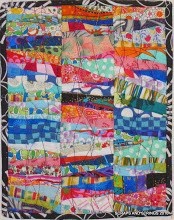
And of course, this psalm also contains the well-loved lines: "This is the day that the Lord has made; let us rejoice and be glad in it." This gives me the chance to post the picture of the quilt I made in honour of my sister's ordination, now hanging in the chapel of the nursing home where she is chaplain. I chose this verse because it is familiar, and because it reminds us that each day is a day to be thankful. And this psalm closes with the same lines it opens with, framing the psalm in thanksgiving and pointing to its liturgical function.

Click on photo to see details

These are the last two Hallel psalms: two short verses in 117 and 29 in 118. Psalm 117 is described as a hymn of praisie, or a universal call to worship by the editors of the NRSV. The few short lines in 117 remind me of the quick prayers before meals that my sons chant off when they're really hungry, so rapidly that my mind can barely register a mood of thankfulness. The journalist in me likes the all-encompassing theology in Psalm 117: in two verses the psalmist lays out the heart of the psalms. Praise God because God loves us forever. Praise God!
Psalm 118 is a communal thanksgiving psalm which repeats the ideas and phrases of Psalm 117 in its opening lines: "O give thanks to the Lord, for he is good; his steadfast love endures forever." This psalm repeats imagery we've seen elsewhere in the Psalms -- that of entering the gates of righteousness, God's royal court, and contains lines we will see later in the New Testament, such as verse 22: "The stone that the builders rejected has become the chief cornerstone."
And of course, this psalm also contains the well-loved lines: "This is the day that the Lord has made; let us rejoice and be glad in it." This gives me the chance to post the picture of the quilt I made in honour of my sister's ordination, now hanging in the chapel of the nursing home where she is chaplain. I chose this verse because it is familiar, and because it reminds us that each day is a day to be thankful. And this psalm closes with the same lines it opens with, framing the psalm in thanksgiving and pointing to its liturgical function.
Friday, November 13, 2009
Two for one
Psalm 115 and 116: Two more psalms in the series of Hallel psalms, one a trust hymn, the other a psalm of individual salvation. According to one Konrad Schaefer's commentary, Psalm 116 is actually two psalms in Greek and Latin translations, with v. 1-9 appearing as Psalm 114 and 10-19 as Psalm 115. He says the first part of this psalm is a cry for help, where the psalmist is close to death, and God's response, and the second part is a liturgical response to the situation. What resonates here with me is the opening line: "I love the Lord because he has heard my voice and my supplications." That affirmation is paralleled in v. 2, with the psalmist affirming that he/she will call on God for the remainder of his/her life. Further on, another affirmation of life: "I walk before the Lord in the land of the living."(v. 9) No longer is the psalmist near death as in verse 3, but walks with God, clearly on the side of life, not death, a parallel thought from v. 8, where the psalmist proclaims that God delivered him/her from death and kept his/her feet from stumbling. The first half of this psalm is an affirmation of life, even in the face of grave danger or illness, and that because God delivers from death, the psalmist keeps his/her life and faith.
Thursday, November 12, 2009
Lifting the needy from the ash heap
Psalms 113 and 114: Psalm 113 is the first of six Egyptian Hallel psalms, sung at the festivals and before and after Passover meals. Hallel comes from the Hebrew hallelu which is a plural imperative of praise and from a shortened name of God, Yah. Hallelujah appears 23 times in the Psalms, from 104 to 150. Holliday says the phrase had a special significance and was the highest form of praise. These two are short psalms, only 8 or 9 verses, with 113 opening with praise and adoration of God who is seated on high. What's interesting about this psalm are the three inversions at the end, instances of the first being last and the last first that Christians are familiar with from the Gospels. In this psalm, God raised the poor from the dust and lifts the needy from the ash heap (v. 7) to sit with prince. God also is a God of fertility and blessing, giving a home to the barren woman and making her a mother. Barren women at the time had no place in Hebrew extended families, since their current and future support came from having children. A woman without children had no status and the Old Testament is full of women who were determined to become mothers--Sarah, Tamar, and Ruth to name a few.
Psalm 114 is a brief and succint theological history of the Hebrews, telling the story of the exodus from Egypt and the kingship, and construction of the temple right at the beginning. This short bit of Hebrew poetry is constructed in pairs, but as James Mays points out in his commentary, it is playful and exuberant, with mountains skipping like rams and hills skipping like lambs. There's even a bit of alliteration in the English translation!
In the final line, the earth trembles at the presence of the Lord, an image that runs through the psalms as creation and nations and other gods quake at the sight of the Almighty Yahweh. And my classmates might be interested in the creation theme running through this psalm, with lots of images of flora and fauna. God turns rock into water, a life-giving sustenance, a sign of growth and goodness.
Wednesday, November 11, 2009
Happy are those who fear the Lord
Psalms 110, 111 and 112: I'm reading three psalms today, not only to ensure I finish by the end of the month, but also because Psalms 111 and 112 are meant to be read as a pair. James Mays says they are a diptych, which have related language and form and topics, and both are acrostic poems of 22 measures, each beginning with a successive letter of the Hebrew alphabet. Since I don't read Hebrew, some of those literary devices are lost on me, but I can see the similiarities in English translation. Each have 10 verses, begin with the same line: "Praise the Lord!" and the final verse of 111 links to the opening verse in 112. "The fear of the Lord is the beginning of wisdom" (111:10) and "Happy are those who fear the Lord" (112:1) The first psalm in the pair focuses on the the wonderful deeds of God and the second gives instruction about righteous living. God is great, and those who love God will be blessed. Although there's much about this psalm that could be picked apart and explained (I'm in the middle of an exegesis of another psalm today), I'll point out just one thing. At the end of 111, God's praise endures forever. Psalm 112 ends with a contrasting thought to the power of God and the blessing on those who are faithful: the wicked melt away and their desire comes to nothing.
Tuesday, November 10, 2009
Wrapped in vengeance, clothed with dishonour
Psalms 108 and 109: What's interesting to me as I make my way through the Psalms is how some themes are repeated over and over again, and sometimes even whole lines or paragraphs are repeated. I suppose the short answer to why that is is the evolution of the individual psalms: some were sung and chanted in liturgy and parts were used during praise or prayer, just as we sing or chant some of the same lines today. That's probably why the opening verses of Psalm 108 are the same words of praise as found in Psalm 57: 7-11.
In Psalm 109, the image of clothing and garments and being wrapped in a mantle are applied to the wicked, where earlier they referred to the righteous (Psalm 102). Psalm 109 is an individual lament with a long list of accusation of curses against the wicked man, who is "clothed with cursing as his coat" (v. 18) and the curses are like a garment wrapped around him. (v. 19). At the conclusion of the psalm, the psalmist asks that the assailants be clothed with dishonour and wrapped in their own shame like a mantle (v. 29). Although we often view clothing as exterior, our culture will judge people by how they are dressed, and it isn't a large leap to think that the Hebrews were also judged on the quality of their clothing and how they presented themselves to the world.
In Psalm 109, the image of clothing and garments and being wrapped in a mantle are applied to the wicked, where earlier they referred to the righteous (Psalm 102). Psalm 109 is an individual lament with a long list of accusation of curses against the wicked man, who is "clothed with cursing as his coat" (v. 18) and the curses are like a garment wrapped around him. (v. 19). At the conclusion of the psalm, the psalmist asks that the assailants be clothed with dishonour and wrapped in their own shame like a mantle (v. 29). Although we often view clothing as exterior, our culture will judge people by how they are dressed, and it isn't a large leap to think that the Hebrews were also judged on the quality of their clothing and how they presented themselves to the world.
Monday, November 9, 2009
All I can think of is food
Psalm 107: This is the first psalm of Book V of the Psalms, a community thanksgiving written in clearly defined stanzas, and without a superscription. That's all fine and good, but somehow when I read the 43 verses of this psalm today, the references to food jumped out at me. Now I'm a well-fed (maybe even over-fed) Canadian, and I haven't experienced hunger in any way except as an inconvenience, so why this obsession with food? But it's everywhere in this psalm, beginning with v. 4 where those wandering in the desert faint from lack of food and later God helps them, and "fills them with good things." v. 9. In the third stanza, a thanksgiving of those healed and forgiven, the wicked are being described as sick and afflicted, unable to eat (v. 18), and near death. In the thanksgiving of those saved from the dangers of the sea, the sailors are described as staggering like drunkards (v. 27), probably from the effects of sea sickness. And then in the concluding hymn of praise, God is described as turning springs into thirsty ground and fruitful land into salty waste (v. 33), the opposite of nourishment, because of wickedness, while the faithful receive pools of water and life by sowing crops and planting vineyards (v. 35-37). Even the cattle thrive, and the people multiply, most likely because they don't have to worry about hunger and starvation. God provides for the needy and hungry, and what better metaphor than nourishment and sustenance to understand the faithfulness and greatness of God.
Sunday, November 8, 2009
Remember me when you show favour to your people
Psalm 106: A quote from the final psalm of Book IV:
Sunday quote:
Both we and our ancestors have sinned;
we have committed iniquity, have done wickedly.
Our ancestors, when they were in Egypt,
did not consider your wonderful works;
they did not remember the abundance of your steadfast love,
but rebelled against the Most High at the Red Sea.
Yet he saved them for his name's sake,
so that he might make known his mighty power.
Psalm 106: 6-8.
Friday, November 6, 2009
Seek God's presence continually
Psalm 105: This is a lengthy hymn of praise for God's wonderful works for the people of Israel. In its 45 verses, the psalmist recounts the history of God's faithfulness to the Hebrew, right from the covenant with Abraham to the exodus from Egypt, with many details of famine and suffering along the way. We've seen these theological histories earlier in the psalms. What strikes me with this one, the second last psalm in Book IV, are the opening verses which call on the people to give thanks to God. After being called to sing and praise and glory in God's holy name, the point of this psalm in laid out in verses 4, to 6, what journalists call the nut graph, or the focus of the story. Here the focus is a theological admonition:
"Seek the Lord and his strength; seek his presence continually. Remember the wonderful works he has done, his miracles and the judgements he has uttered, O offspring of his servant Abraham, children of Jacob, his chosen ones."
After dozens of preceding psalms where the psalmist has been pleading to be in the presence of God, here the psalmist is saying something else. It's more like: Remember God and remember where you come from.
Yet's there's something more that speaks to me here. What does it mean to seek the Lord and the Lord's strength, and seek the Lord's presence continually? This seems to be a admonition to faithfulness, to look to God, not to human kings or governments or each other, especially important in during the exile when the human structures had failed them. The psalmist is reminding them of God's faithfulness in the past, and that God will continue to be faithful and the people of Israel need to seek out God to again experience that faithfulness. It's a familiar theme, but one that bears repeating: seek his presence continually.
Thursday, November 5, 2009
Giving drink to every wild animal
Psalms 103 and 104: Psalm 104 is a lengthy hymn to God as creator, detailing God's power and majesty through the created world and all creatures in it. This psalm has some lovely lines in it: "you make the clouds your chariot you ride on the wings of the wind, you make the wind your messengers, fire and flame your ministers." Where else but the psalms could the wind carry the message of God and fire a minister of God? After a series of enthronement psalms, God is shown to be king, but the royal language isn't used here except in the opening lines, where God is clothed with honor and majesty and wrapped in light.
All creation and all creatures on it have direct access to God in this psalm, Walker-Jones says, remarkable because that access extends beyond just humans. Animals and other creatures look to God for their food and sustenance, and hey, even a little wine:
"You cause the grass to grow for the cattle, and plants for people to use, to bring forth food from the earth, and wine to gladden the human heart, oil to make the face shine," v. 14-15. In this psalm, God is definitely the God of creation, the one on whom everything else depends on for life. And the psalmist reminds us that God rejoices in the work of creation (v. 31), suggesting we can enjoy it too.
Wednesday, November 4, 2009
They will all wear out like a garment
Psalms 101 and 102: Like any other mother of sons, I am always finding holes in their clothes: knees of jeans gone out, socks that can't be comfortable to wear, or a favourte t-shirt worn down to rags. Clothes wear out, especially when put to hard use of the life of teenage boys. And as much as I would wish it, they don't magically regenerate like new skin on a cut or grass on the lawn. If they are going to be repaired, I'm the one who will have to do it.
Fibers fray and tear, but the earth? All of creation? Psalm 102: 25-26 suggests that. After a long lament, the psalmist turns his/her attention to creation at the end of the psalm and how it will "wear out like a garment" and heaven and earth with perish, but God remains. I suppose the psalmist is speaking to faith in the unchangeable nature of God, that God remains faithful despite human failures, but the image is disturbing in light of the current ecological crisis. We now fear that the earth will wear out, but most people don't celebrate that fact in the same way the psalmist appears to. For how can people continue to live on a worn out earth, as verse 28 suggests the children of the faithful will continue to do? Walker-Jones says this psalm contributes to the idea that humanity is above and separate from earth, an earth that must be conquered and subdued.
Fibers fray and tear, but the earth? All of creation? Psalm 102: 25-26 suggests that. After a long lament, the psalmist turns his/her attention to creation at the end of the psalm and how it will "wear out like a garment" and heaven and earth with perish, but God remains. I suppose the psalmist is speaking to faith in the unchangeable nature of God, that God remains faithful despite human failures, but the image is disturbing in light of the current ecological crisis. We now fear that the earth will wear out, but most people don't celebrate that fact in the same way the psalmist appears to. For how can people continue to live on a worn out earth, as verse 28 suggests the children of the faithful will continue to do? Walker-Jones says this psalm contributes to the idea that humanity is above and separate from earth, an earth that must be conquered and subdued.
Tuesday, November 3, 2009
Make a joyful noise....again!
Psalms 99 and 100: I've reached the last enthronement psalm (99) of Book IV, followed by a hymn. Psalm 99 is slightly different from those previous, recalling the theological history of the Hebrew by invoking the names of "faithful intercessors for Israel" (HC Study Bible): Moses, Aaron, and Samuel. Like the other enthronment psalms, Ps. 99 begins with a declaration of God as king, referring again to the loss of the human king due to the exhile.
The words of Psalm 100 are familiar for several reasons -- many hymns and praise songs in current hymnody use these words, and because I've just read nearly the same text in the first five verses of Ps. 95. That one has more creation imagery, while the five short verses in Ps. 100 uses the sheep/shepherd imagery used earlier in the psalter (Ps. 23 for one) as well as kingly imagery in verse 4: "enter his gates with thanksgiving and his courts with praise. " My study Bible says verses 4 and 5, which summon people to praise and thanksgiving are a reflection of a prayer of thanksgiving.
The last verse is another theological affirmation of the mightiness and greatness of God: God is good, God's love endures forever, and so does God's faithfulness. Walker-Jones says this psalm calls for the worship of the God who has created us, an acknowledgement that God is king and the human monarchy has failed.
Monday, November 2, 2009
Sing a new song
Psalms 97 and 98: Right now, I'm in the middle of a series of enthronement hymns (Psalms 93 to 99) and there are recurring themes. One of them is in the title, the other is the proclamation that the Lord is King. That's a familiar theme for Christians, since we sing that line in our hymns, but we probably don't understand the depth of that proclamation for the Hebrew people. We sing them as general praise songs and don't often consider their historical context, of how these psalms proclaim God as king during a time when they had no king or were under the rule of a foreign king. The Hebrews were indeed proclaiming that God was king alone of their people and no human rule was greater than that of God. Walker-Jones says these enthronement psalms could be considered a subversive confession since the Hebrews were saying they submitted to a greater power than the current human empire. He says the storm imagery evident in Psalm 97 are a major metaphor for God in these enthronement psalms, where fire consumes adversarieis, and lightning lights up the world and mountains melt like way (v. 4 and 5).
Psalm 98 contains lots of encouragement to sing to Lord/King, and the storm imagery is used here to praise: the floods clap, the sea roars, and the hills sing. Creation is acknowledging the kingship of God even in terrible or catastrophic events.
Psalm 98 contains lots of encouragement to sing to Lord/King, and the storm imagery is used here to praise: the floods clap, the sea roars, and the hills sing. Creation is acknowledging the kingship of God even in terrible or catastrophic events.
Sunday, November 1, 2009
Sunday quotes
Psalms 95 and 96:
Quote #1
For the Lord is a great God,
and a great Kind above all gods.
In his hand are the depths of the earth;
the height of the mountains are his also.
The sea is his, for he made it.
and the dry land, which his hands have formed.
Psalm 95:3-5
Quote #2
Let the heavens be glad, and let the earth rejoice;
let the sea roar, and all that fills it;
Then shall all the trees of the forest sing for joy
before the Lord
Psalm 96: 11-13a
Subscribe to:
Posts (Atom)


 Posts


